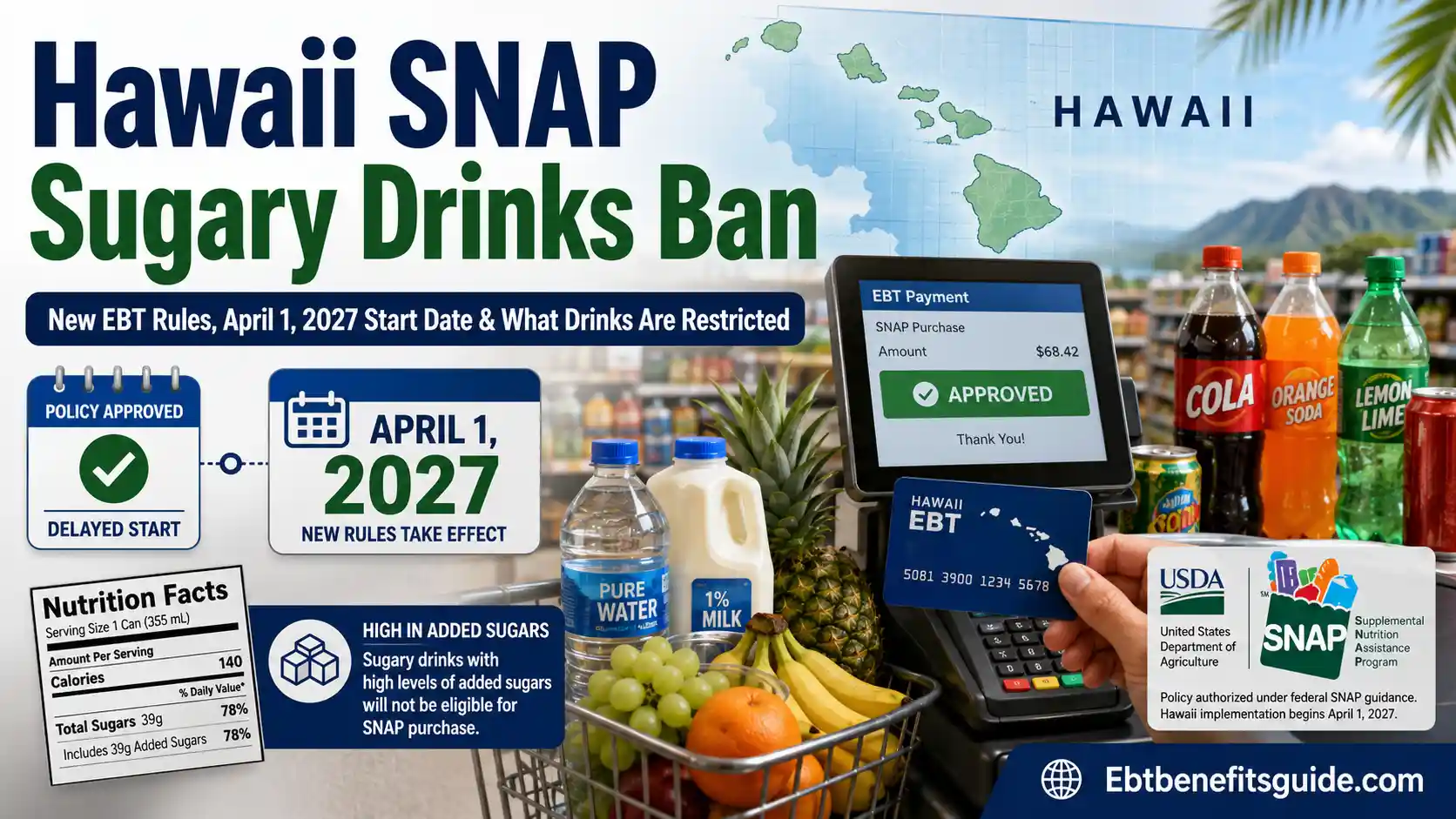
No. Right now, Hawaii SNAP recipients can still use their EBT card the way they always have. The USDA approved Hawaii’s SNAP food restriction waiver, then later approved a separate new change pushing the start date from August 1, 2026, to April 1, 2027.
That gap matters. Plenty of older articles floating around still list August 2026 as the deadline, and that’s just outdated information at this point.
USDA’s current Hawaii waiver page confirms the revised date, so there’s no ambiguity here — the restriction exists on paper, but it isn’t live.
What Is the Hawaii SNAP Sugary Drinks Ban?
People call it a “sugary drinks ban,” but technically it’s a USDA-approved SNAP Food Restriction Waiver Demonstration Project, requested by Hawaii’s Department of Human Services (DHS).
The policy narrows what SNAP dollars can purchase by excluding certain soft drinks from the eligible items list. Hawaii filed the request on October 10, 2025. USDA signed off two months later, on December 10, 2025 (Food and Nutrition Service).
This isn’t a permanent overhaul, either — it’s a two-year demonstration project, and USDA will be evaluating how it plays out for both SNAP participants and retailers.
Who Is Affected?
Statewide. Not just Honolulu, not just Oʻahu — every island.
That includes SNAP households on:
- Oʻahu
- Maui
- Hawaiʻi Island, including Hilo and Kona
- Kauaʻi
- Other Hawaii communities
Same rules, same timeline, everywhere. Hawaii’s SNAP program runs through DHS’s Benefit, Employment & Support Services Division (BESSD), while SNAP itself remains a federally administered program under USDA (Department of Human Services).
When Does the Hawaii SNAP Soda Ban Start?
April 1, 2027. That’s the number to remember.
The original approval had it starting August 1, 2026. Then, on June 15, 2026, USDA approved Hawaii’s request to delay it (Farmers.gov).
Hawaii SNAP Soda Ban Timeline
| Date | What Happened |
|---|---|
| October 10, 2025 | Hawaii formally requested the SNAP food restriction waiver |
| December 10, 2025 | USDA approved the demonstration project |
| August 1, 2026 | Original implementation date |
| June 15, 2026 | USDA approved Hawaii’s request to change the implementation date |
| April 1, 2027 | Current revised implementation date |
| Worth repeating: an approved waiver is not the same thing as an active purchasing restriction. Hawaii has the former right now, not the latter. |
What Counts as a “Soft Drink” Under Hawaii SNAP Rules?
This is where most of the confusion lives.
The approved definition covers a nonalcoholic beverage made with carbonated water, sweetened with more than 10 grams of sugar per serving. A handful of beverage categories are specifically carved out.
So it’s not “anything with sugar in it.” It’s a narrow, specific definition — carbonation plus a sugar threshold, nothing broader.
A qualifying restricted beverage generally needs all three of these:
- Nonalcoholic
- Carbonated water as an ingredient
- More than 10 grams of sugar per serving
Don’t assume every “sweetened drink” on a shelf automatically falls under this rule. Formulation is what decides it, not marketing language.
Which Drinks Could Be Restricted?
Once the rule kicks in, common carbonated sugary sodas are the main target.
| Beverage Type | Current Status | After April 1, 2027 |
|---|---|---|
| Qualifying regular soda | SNAP eligible under current rules | Restricted |
| Sugary carbonated soft drink | SNAP eligible under current rules | Restricted if it meets the definition |
| Milk-based beverage | Generally eligible | Outside the soft-drink definition |
| Milk substitute beverage | Generally eligible | Outside the stated definition |
| Beverage over 50% fruit or vegetable juice | Generally eligible | Outside the stated definition |
| Plain water | Eligible | Eligible |
| Sparkling water without qualifying added sugar | Generally eligible | Generally outside the definition |
| Classification comes down to formulation and labeling on a product-by-product basis. Two sodas from the same brand can land in different buckets. |
Does Hawaii SNAP Ban Diet Soda?
Not automatically — and this trips people up constantly.
Hawaii’s definition hinges on sugar content: more than 10 grams per serving, carbonated, nonalcoholic (Farmers.gov). Diet and zero-sugar drinks don’t automatically qualify just because they’re fizzy.
Check the actual formulation when the rule goes live, and let the retailer’s SNAP system make the final call at checkout.
Can You Buy Coke or Pepsi With EBT in Hawaii?
Right now? Yes, under the rules currently in effect.
After April 1, 2027, brand name alone won’t decide anything. What matters is the ingredient list.
Don’t assume Coca-Cola, Pepsi, Sprite, and Mountain Dew will all land in the same category — sugar content and formulation vary by product, even within one brand’s lineup.
The practical rule: check the specific beverage against Hawaii’s soft-drink definition rather than relying on the label’s name recognition. If you’re also tracking state-by-state income eligibility rules for SNAP, it’s a good idea to bookmark that alongside this policy, since both affect what your household can ultimately buy and how far your benefits stretch.
What About Juice?
Good news for juice drinkers — there’s a real exception here.
A beverage that’s more than 50% fruit or vegetable juice by volume falls outside the soft-drink definition entirely (Farmers.gov).
So the distinction shoppers need to make is:
- Fruit or vegetable juice products
- Juice drinks with lower juice content
- Carbonated sugary beverages
Read the juice percentage on the label. It genuinely matters here.
What About Milk, Soy Milk, or Other Milk Substitutes?
Also excluded. Milk, milk products, soy, rice, and other milk substitutes don’t fall into the restricted soft-drink category (National Grocers).
A drink can technically contain sugar and still be completely fine under this rule. Sugar alone isn’t the trigger — carbonation plus sugar is.
Look at what’s actually in the product. Don’t assume “sweetened” automatically means “banned.”
What About Energy Drinks and Sports Drinks?
Another spot where assumptions get people in trouble.
Hawaii’s waiver specifically targets soft drinks — it doesn’t use the broader sweetened-beverage categories some other states have adopted. USDA’s waiver tracker separates Hawaii from states whose restrictions cover energy drinks or sports drinks (Food and Nutrition Service).
Whether your specific energy or sports drink gets restricted will come down to Hawaii’s final implementation guidance and the product’s actual formulation.
How Will the Hawaii EBT Restriction Work?
Fairly simple, in practice:
- A SNAP household selects groceries at a SNAP-authorized retailer.
- The retailer’s system flags which items are SNAP-eligible.
- A qualifying restricted soft drink won’t process under SNAP.
- The shopper removes the item, or pays for it another way if that option exists.
- Every other eligible item still goes through on SNAP normally.
One declined item doesn’t mean your EBT card is broken or your benefits are gone. It just means that one purchase doesn’t qualify under the new food rules.
Will the Ban Affect SNAP Eligibility?
No — and this is a distinction worth sitting with for a second.
A food-purchase restriction changes what you can buy. It has nothing to do with whether your household stays enrolled in SNAP.
Hawaii DHS handles SNAP eligibility and benefit administration completely separately from this kind of product restriction (Department of Human Services).
Why Is Hawaii Restricting Soft Drinks?
Part of a broader push to test SNAP purchasing rules and nudge healthier choices, honestly.
USDA describes the project as a demonstration that will be evaluated for its effects on both participants and retailers.
Supporters argue that cutting sugary drinks from SNAP purchases could improve health outcomes over time. Critics push back on consumer choice, product classification headaches, and whether SNAP households should face different rules than everyone else at the register.
Either way, Hawaii’s project functions as both a nutrition experiment and a real-world stress test of how a restricted-purchase SNAP system actually operates.
What Should Hawaii SNAP Recipients Do Now?
Nothing urgent. April 1, 2027 is still a ways off, and August 2026 is no longer the operative date.
For now:
- Keep following Hawaii’s current SNAP purchasing rules
- Watch for DHS announcements on implementation details
- Check USDA’s Hawaii SNAP waiver page for federal updates
- Track your EBT balance and hold onto receipts like usual
- Pay attention to retailer notices once the restriction gets closer
It’s also worth knowing what else your EBT card can unlock beyond groceries — Hawaii shoppers can check EBT discount programs available by state for savings that have nothing to do with this restriction. And if you’re not sure when your next deposit lands, the EBT payment schedule by state covers Hawaii’s disbursement dates too.
For direct questions, Hawaii DHS runs BESSD as the division responsible for SNAP administration. Their Public Assistance Information Line is 1-855-643-1643 (Department of Human Services).
Hawaii SNAP Sugary Drinks Ban: Quick Comparison
| Question | Answer |
|---|---|
| Is the ban approved? | Yes |
| Is it active now? | No |
| Original start date | August 1, 2026 |
| Current start date | April 1, 2027 |
| Applies statewide? | Yes |
| Who is affected? | Hawaii SNAP households |
| What is restricted? | Qualifying soft drinks |
| Sugar threshold | More than 10g sugar per serving |
| Milk/milk substitutes excluded? | Yes |
| >50% fruit/vegetable juice excluded? | Yes |
| Does it cancel SNAP benefits? | No |
What Happens If Your EBT Card Declines a Soda?
Don’t panic — a decline here isn’t automatically a card problem.
Once the restriction is active, a restricted drink simply won’t process as a SNAP item. If that happens:
- Ask the cashier which item got rejected.
- Remove it, or pay separately if that’s an option at that register.
- Confirm your other groceries still went through on SNAP.
- Contact Hawaii DHS if you think an eligible item was flagged by mistake.
Retailer systems will need to catch up to the new rule too, so expect some friction in the first few weeks after implementation. Hawaii isn’t the only state experimenting with SNAP food restrictions, either — if you’re curious how other states have approached similar policies, the SNAP junk food ban list by state breaks down what’s already in effect elsewhere.
The Bottom Line for Hawaii Shoppers
Simple version: Hawaii’s SNAP soft-drink restriction is approved but not active. It’s been pushed to April 1, 2027.
Until then, ignore the August 2026 date wherever you see it. After implementation, qualifying nonalcoholic carbonated beverages with more than 10 grams of sugar per serving get excluded from SNAP purchases, with clear exceptions for juice and milk-based drinks (Farmers.gov).
FAQs About Hawaii SNAP Soda Restrictions
Can you buy soda with EBT in Hawaii right now?
Yes. The restriction isn’t active yet — USDA pushed the start date to April 1, 2027 (Farmers.gov).
When does the Hawaii SNAP sugary drinks ban start?
April 1, 2027. It was originally set for August 1, 2026 before USDA approved the delay.
What drinks are banned from SNAP in Hawaii?
Qualifying soft drinks — nonalcoholic, carbonated, more than 10 grams of sugar per serving, with specific exceptions built in (Farmers.gov).
Does the Hawaii SNAP ban include diet soda?
Not automatically. The rule is built around sugar content, so zero-sugar drinks generally sit outside the definition.
Can SNAP buy juice in Hawaii?
Yes, in most cases. Beverages that are more than 50 percent fresh fruit or vegetable juice by volume are excluded from the soft-drink definition (Farmers.gov).
Can SNAP buy milk drinks in Hawaii?
Yes. Milk, milk products, soy, rice, and other milk substitutes are excluded from the restriction entirely (National Grocers).
Does the Hawaii SNAP soda restriction apply statewide?
Yes — Oʻahu, Maui, Hawaiʻi Island, Kauaʻi, all of it.
Will Hawaii’s EBT card stop working for soda?
No, the card itself keeps working fine. Restricted drinks just won’t be payable with SNAP funds once the rule takes effect.
Can SNAP recipients opt out of the restriction?
No. This is a purchasing rule, not an optional program feature.
Will the Hawaii SNAP ban affect my SNAP eligibility?
No. It changes what you can buy, not whether you qualify for the program.
Conclusion
Mark April 1, 2027 on your calendar and let the August 2026 date go. That’s really all this comes down to for most Hawaii households.
The details that matter — the sugar threshold, the juice exception, the milk exception — are worth knowing before the rule goes live, not after you’re standing at a register trying to figure out why something didn’t ring up. Keep an eye on DHS new rules as the date gets closer, and you’ll be fine.
Official Resources
- Check the Hawaii Waiver Status — USDA Food and Nutrition Administration
- See All Approved SNAP Food Restriction Waivers — USDA FNA
- Verify Your SNAP Benefits — Hawaii DHS BESSD
- Apply or Check Your Case — Hawaii PAIS Benefits Portal
Disclaimer: This article is for general informational guidance only and is not legal, financial, or government advice. SNAP policies and implementation details can change any time. For the current eligibility and purchasing guidance, verify information with Hawaii DHS or USDA before making decisions about SNAP benefits.

I am the author of EBTBenefitsGuide.com, with 3 years of experience covering SNAP and EBT benefits. They are dedicated to providing accurate, up-to-date details to help readers navigate government assistance programs with confidence.