Most people assume EBT cards work for bread, milk, and produce. That’s it. Honestly, that assumption leaves real money on the table — because SNAP covers a much wider range of products than most shoppers realize.
SNAP generally covers food intended for household consumption. That includes ordinary groceries, but also food-producing plants and seeds, live shellfish, ice, bottled water, bakery products, and certain prepared foods. The federal rules set the baseline. What actually happens at checkout depends on product labeling, state restrictions, temperature, retailer classification, and how an item is sold.
Before diving in, it helps to know your state’s current SNAP food restrictions — because an item that’s federally eligible may not be eligible everywhere.
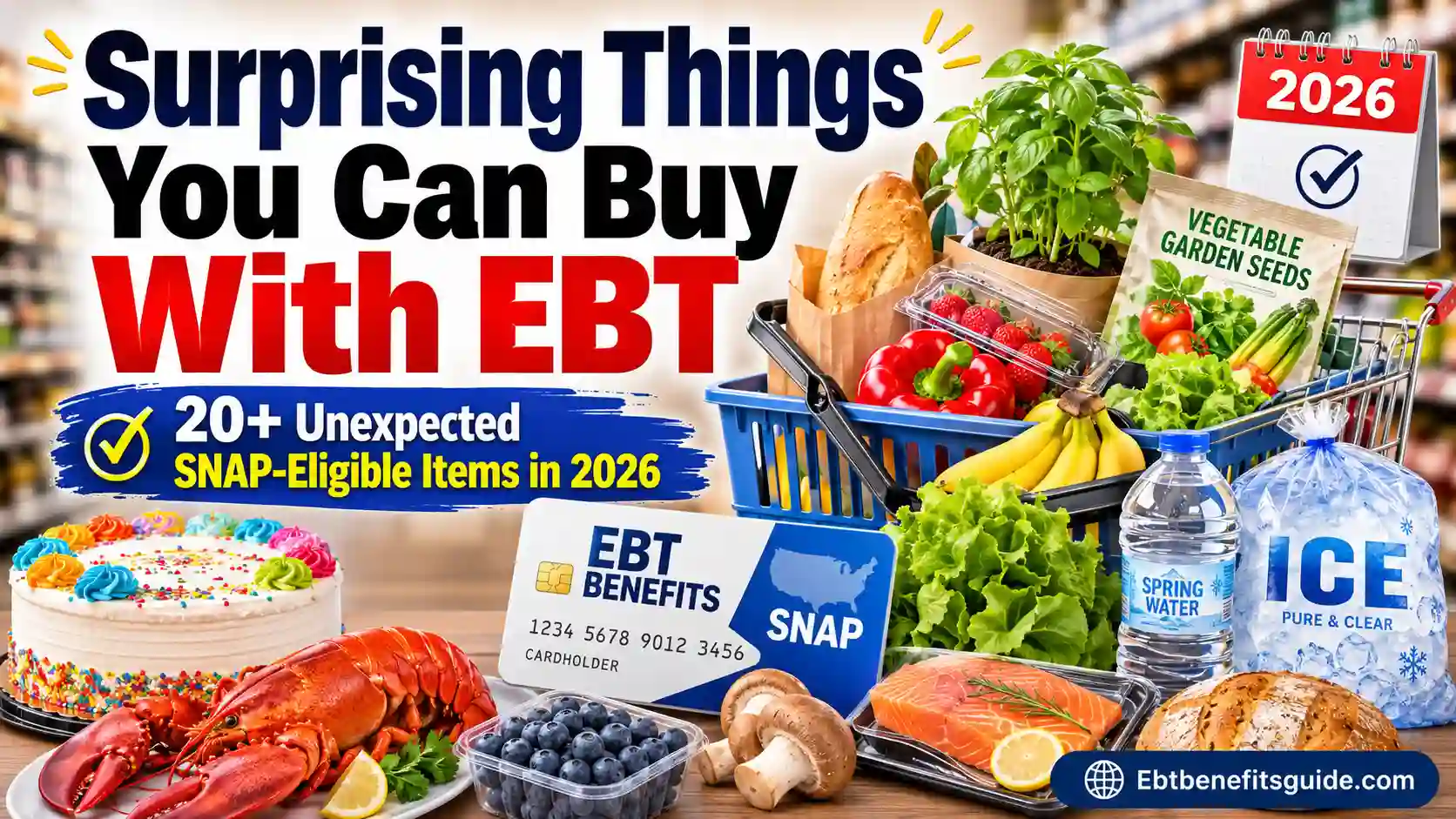
20+ Surprising Things You Can Buy With EBT
| Item | Generally Eligible? | Important Condition |
|---|---|---|
| Garden seeds | Yes | Must produce food |
| Food-producing plants | Yes | Must produce food for the household |
| Fruit trees | Generally yes | Must be food-producing |
| Live lobster | Yes | Food use; not a pet |
| Live crab | Yes | Food use |
| Certain live fish | Yes | Must fit SNAP’s food rules |
| Bottled water | Generally yes | Must be an eligible food/beverage |
| Ice | Generally yes | Purchased as food |
| Coffee | Generally yes | Food/drink for household use |
| Tea | Generally yes | Food/drink for household use |
| Bakery cakes | Generally yes | Product must qualify as food |
| Food gift baskets | Sometimes | Eligible food must meet applicable rules |
| Take-and-bake pizza | Often | Treatment at sale matters |
| Cold prepared foods | Often | Must meet SNAP rules and retailer classification |
| Non-alcoholic beverages | Generally yes | State restrictions may apply |
| Certain energy drinks | Depends | Label and state restrictions matter |
| Protein drinks | Depends | Nutrition Facts vs. Supplement Facts matters |
| Meal-replacement products | Depends | Product classification matters |
| Specialty food ingredients | Generally yes | Must be food intended for consumption |
| Food platters | Depends | Preparation and sale conditions matter |
| Organic foods | Generally yes | Price or organic status does not automatically disqualify food |
| Gluten-free foods | Generally yes | Must otherwise qualify as food |
This table is a practical guide — not a guarantee that every product in a category works at every checkout.
1. Garden Seeds and Food-Producing Plants
This one surprises almost everyone. You can buy seeds with EBT.
USDA explicitly lists seeds and plants that produce food for the household as SNAP-eligible — vegetable seeds, herb plants, fruit-producing plants, all of it. Households that grow tomatoes, peppers, or herbs can stretch their food budget significantly this way.
The line is drawn at gardening supplies. Soil, fertilizer, tools — none of that qualifies.
2. Live Lobster, Crab, and Other Shellfish
Live lobster purchased as food is SNAP-eligible. USDA’s rules include a specific exception for shellfish and fish removed from water, which puts seafood in a category most people never think to use their EBT card for.
The distinction that matters: food versus a pet. A lobster going home to be cooked qualifies. One going into an aquarium does not.
3. Ice
Ice reads like a household supply. USDA’s guidance classifies it as a product that can qualify under SNAP food determinations — eligibility is about how a product is classified, not whether it looks like a food item.
4. Bottled Water
SNAP covers allowed non-alcoholic beverages, and bottled water fits that category at any SNAP-authorized retailer. Simple as that.
5. Birthday Cakes and Bakery Products
A birthday cake is food, so it can qualify. Non-food components bundled with a cake — separate decorations, non-edible accessories — can create a split at checkout between eligible and non-eligible portions.
The cake itself is usually fine. What’s attached to it sometimes isn’t.
6. Food Gift Baskets
Food gift baskets are conditional. A basket filled primarily with eligible food can qualify — but non-food merchandise included in the same basket creates an ineligible portion. When in doubt, ask the retailer if the food items can be rung up separately.
7. Take-and-Bake Pizza
Here’s where temperature starts to matter. USDA draws a clear line between food intended for household preparation and food that’s hot at the point of sale. A cold, unbaked pizza you take home and cook yourself is treated differently from one the store has already heated. Cold preparation for home use — that’s the key.
8. Cold Prepared Foods
Cold sandwiches, salads, fruit cups — these can qualify. The same item served hot may not. USDA’s retailer guidance specifically distinguishes hot food from cold prepared food, and that distinction affects eligibility at checkout.
9. Coffee and Tea
Coffee and tea for household consumption fall within SNAP’s eligible food and beverage category. Anything marketed as a dietary supplement or sold with a Supplement Facts label is a different conversation entirely.
10. Certain Energy Drinks
Energy drinks need a label check. USDA tells retailers not to accept SNAP for products bearing a Supplement Facts label — and some energy drinks and shots carry exactly that. Others are classified as beverages with Nutrition Facts labels and may qualify.
There’s a second layer: several states now have USDA-approved SNAP food restrictions that specifically target energy drinks, soft drinks, or candy. Don’t assume national eligibility applies in your state.
11. Protein Drinks and Shakes
The product name and marketing don’t determine eligibility. The label does.
- Nutrition Facts label: May qualify if it otherwise meets SNAP rules
- Supplement Facts label: USDA classifies this as a supplement — not SNAP-eligible
That’s the fastest check for any questionable protein drink or meal replacement.
12. Organic, Vegan, and Gluten-Free Foods
None of these labels disqualify a product. If it’s food intended for household consumption, it can fall within SNAP’s eligible framework regardless of whether it costs more or carries a specialty dietary label. SNAP eligibility is about what the product is — not what it costs or how it’s marketed.
13. Specialty Ingredients
Expensive spices, specialty grains, imported sauces, artisan baking ingredients — price alone does not determine eligibility. If it’s food meant to be prepared and eaten at home, it has a real chance of qualifying.
14. Non-Alcoholic Beverages
SNAP covers qualifying non-alcoholic beverages broadly. State-level waivers approved under USDA’s 2026 process can change what’s eligible in specific states, so checking your state’s current SNAP rules is worth doing before you shop.
15. Bakery Breads and Prepared Bakery Foods
Bread, cereals, pastries — these sit squarely within standard SNAP food categories. Eligible at supermarkets, bakeries, and any other SNAP-authorized retailer, provided the retailer is authorized and the product qualifies.
16. Seafood Purchased Live
USDA’s eligible-food guidance recognizes shellfish and fish removed from water as a special category. Live seafood purchased as food can qualify — the live status at the time of purchase doesn’t automatically disqualify it.
17. Cold Food From a Grocery Store
A grocery store selling ready-to-eat food cold operates under different SNAP rules than a place serving the same food hot. USDA specifically distinguishes hot food from cold prepared food in its retailer guidance. Temperature at the point of sale matters more than most people realize.
18. Food Purchased at Farmers Markets
Farmers markets can participate in Food Stamps, and many also offer incentive programs that stretch benefits further. USDA gives a SNAP Retailer Locator for finding authorized locations near you. Approved purchases include qualifying produce, food items, and food-producing plants or seeds.
Try searching: “farmers market that accepts EBT near me” or “SNAP farmers market near me” to find local options.
19. Online Grocery Purchases
EBT works online at participating retailers. What it can’t pay for: delivery fees, service charges, or convenience fees. You’ll need a second payment method for those. The food itself — eligible products from a participating retailer — can be covered by SNAP. Also worth checking what EBT discounts are available by state to maximize your buying power online and in store.
20. Restaurant Meals in Certain Situations
Standard restaurants don’t accept SNAP just because they take debit cards. The Restaurant Meals Program (RMP) is a specific state option for qualifying SNAP households — elderly, disabled, or homeless individuals in participating states.
As of current USDA RMP information, participating states include Arizona, California, Illinois (certain counties), Maryland, Massachusetts, Michigan, New York, Rhode Island, and Virginia. Your state has to operate an RMP and you have to qualify — searching “EBT restaurants near me” won’t tell you that.
How to Tell if Something Is EBT Eligible
Before buying anything questionable, run through this:
- Is it food for human consumption?
- Does it carry a Nutrition Facts or Supplement Facts label?
- Is it hot at the point of sale?
- Does your state have a SNAP restriction affecting it?
- Is the store or online retailer SNAP-authorized?
Still unclear? Ask the retailer before the transaction completes.
Why Your EBT Card May Decline an Eligible-Looking Item
A declined transaction isn’t always your mistake. Possible reasons:
- The product is coded incorrectly in the retailer’s system
- The product has a Supplement Facts label
- A state restriction applies
- The item is hot at checkout
- The basket includes non-eligible items or fees
- The retailer isn’t SNAP-authorized
- A temporary point-of-sale issue
USDA holds retailers responsible for programming their systems correctly. If something seems wrong, ask the retailer to verify the item’s SNAP classification.
What You Cannot Buy With EBT
SNAP benefits cannot be used for:
- Alcohol
- Tobacco and cigarettes
- Cannabis, marijuana, or CBD products
- Vitamins and medicines
- Dietary supplements (any product with a Supplement Facts label)
- Pet food
- Cleaning supplies
- Paper products and hygiene products
- Cosmetics
- Clothing or gasoline
- Most non-food household items
- Food that is hot at the point of sale
Federal SNAP Rules vs. State Restrictions in 2026
Federal rules provide the baseline — but this is where it gets state-specific. USDA is approving food-restriction waivers in 2026, with current approvals in Arkansas, Colorado, Florida, Hawaii, Idaho, Indiana, Iowa, Louisiana, Missouri, Nebraska, North Dakota, Oklahoma, South Carolina, Tennessee, Texas, Utah, and West Virginia.
An item that’s federally eligible may not be eligible in your state. Always verify your state’s current rules before relying on a general list — especially if your SNAP payment schedule is coming up and you’re planning a bigger shop.
A Simple Decision Framework
Standing in the aisle wondering if something qualifies? Use this sequence:
Food → Label → Temperature → State → Retailer
If it’s food, carries a Nutrition Facts label, isn’t excluded by how it’s sold or heated, isn’t restricted by your state, and the retailer accepts SNAP — it has a strong chance of qualifying.
FAQs About surprising things you can buy with EBT
Can you buy lobster with EBT?
Yes. USDA SNAP rules include a specific exception for live shellfish and fish, so qualifying live lobster purchased as food is eligible. The purchase must be for food — not kept as a pet.
Can you buy seeds with EBT?
Yes. Food-producing seeds and plants qualify because they’re intended to produce food for the household. Tools, soil, and fertilizer are not eligible.
Can you buy cake with EBT?
Generally yes, when the cake eligible as food. Non-food decorations or bundled merchandise can create eligibility issues at checkout.
Can you buy hot food with EBT?
No — with one exception. Foods hot at the point of sale are excluded under standard SNAP rules. The Restaurant Meals Program provides an exception for qualifying clients in participating states.
Can you buy energy drinks with EBT?
Check the label. If the product carries a Nutrition Facts label and your state hasn’t restricted it, it may qualify. A Supplement Facts label means it doesn’t.
Can you buy vitamins with EBT?
No. Vitamins, medicines, and dietary supplements are not SNAP-eligible. Any product with a Supplement Facts label is considered a supplement by USDA.
Can you use EBT online?
Yes, at participating SNAP online retailers. SNAP benefits cannot cover delivery fees, service charges, or convenience fees — a second payment method is needed for those.
Can you use EBT at restaurants?
Not under standard SNAP rules. The Restaurant Meals Program makes exceptions for qualifying elderly, disabled, or homeless SNAP clients in participating states only.
Why won’t my EBT card pay for something that looks eligible?
Common causes: incorrect retailer coding, a Supplement Facts label, a state restriction, or a hot-food classification. Ask the retailer to verify before assuming the item is prohibited.
What are the most surprising things you can buy with EBT?
Food-producing seeds and plants, live shellfish, ice, bottled water, bakery products, qualifying gift baskets, cold prepared foods, and certain specialty beverages. Eligibility always depends on the product, the label, and the rules in your state.
Conclusion
The SNAP program covers more ground than most people expect — and knowing that can make a real difference in how far your benefits stretch. Seeds that grow into months of vegetables. Live lobster. Cold prepared meals. Specialty ingredients you assumed were off-limits.
The list matters less than the framework. Food → Label → Temperature → State → Retailer. Run that check, and you’ll know more at checkout than most shoppers ever do.
Official Resources
- Check What SNAP Covers — USDA Food and Nutrition Administration
- Find SNAP-Authorized Stores Near You — USDA Retailer Locator
- Verify Your SNAP Eligibility — USDA FNA
- See Current State Food Restriction Waivers — USDA FNA
Disclaimer: SNAP rules and state restrictions can change. This article provides general information and is not legal or benefits advice. Always verify questionable purchases with USDA/FNS, your state SNAP agency, or the retailer before using your benefits.

I am the author of EBTBenefitsGuide.com, with 3 years of experience covering SNAP and EBT benefits. They are dedicated to providing accurate, up-to-date details to help readers navigate government assistance programs with confidence.