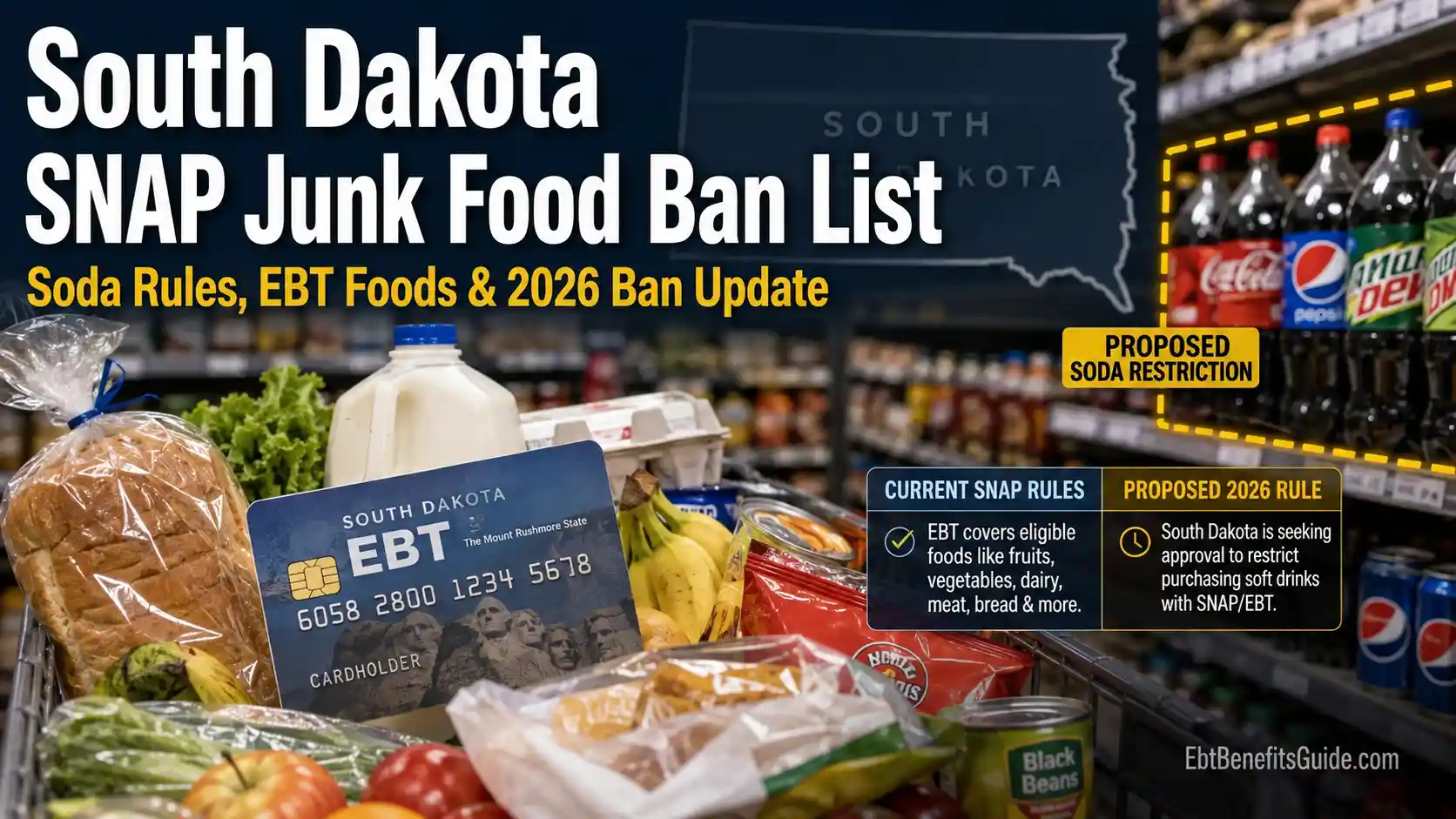
South Dakota does not currently have a broad SNAP junk-food restrictions. As of September, 2026, the state has submitted a USDA waiver seeking to exclude soft drinks from SNAP purchases. If USDA approves it, South Dakota must implement the restriction rules within six months.
Soda isn’t automatically banned from South Dakota EBT just because the waiver got submitted — that distinction trips a lot of people up. “Junk food ban” shows up constantly in searches, but it’s not the precise legal category here. HB 1056 targets soft drinks specifically, nothing more.
Current vs. Proposed South Dakota SNAP Food Restrictions
| Food or beverage | South Dakota SNAP status as of Sept. 5, 2026 |
|---|---|
| Soda / soft drinks | Proposed restriction |
| Diet soda | Potentially covered if it meets the soft-drink definition |
| Candy | Not specifically restricted by HB 1056 |
| Chips | Not specifically restricted by HB 1056 |
| Cookies | Not specifically restricted by HB 1056 |
| Energy drinks | Not specifically named in HB 1056 |
| Milk | Eligible under normal SNAP rules; specifically excluded from proposed soft-drink definition |
| Soy/rice milk substitutes | Specifically excluded from proposed soft-drink definition |
| Certain WIC-approved juices | Specifically excluded from proposed soft-drink definition |
| Alcohol | Not eligible |
| Tobacco | Not eligible |
| Vitamins/medicines | Not eligible |
| Nonfood household items | Not eligible |
| Hot foods | Not eligible |
| DSS says SNAP households can purchase household food such as bread, cereals, fruits, vegetables, meat, fish, poultry and dairy, plus eligible seeds and plants. Checking your household’s SNAP income limits by state is a separate question from anything discussed here. |
Is There a South Dakota SNAP Junk Food Ban in 2026?
No — not a broad one. House Bill 1056 requires the Department of Social Services to request federal approval to exclude soft drinks from eligible SNAP purchases. DSS submitted that waiver to USDA on August 31, 2026.
This matters because the proposal doesn’t say every food people call “junk food” becomes ineligible. Candy, chips, cookies — none of it is targeted. The bill centers entirely on beverages with natural or artificial sweeteners.
South Dakota SNAP Banned Foods List
Two lists matter here: what’s already excluded under standard SNAP rules, and what could become restricted if the waiver clears.
Foods already not eligible under SNAP:
- Beer, wine and liquor
- Cigarettes and tobacco
- Pet food
- Soap and paper products
- Household supplies
- Vitamins and medicines
- Food intended to be eaten in the store
- Hot foods
None of that is new — existing federal SNAP rules, not South Dakota inventions.
Soft drinks under the proposed restriction: HB 1056 defines a soft drink as a nonalcoholic beverage containing natural or artificial sweeteners. The law excludes milk and milk products, rice or soy milk substitutes, and juices approved by the South Dakota Department of Health for WIC eligibility. So the rule reaches further than just “sugary soda” — worth remembering.
Is Soda Banned From SNAP in South Dakota?
Not yet. South Dakota submitted its SNAP Food Restriction Demonstration Waiver to USDA, but filing an application doesn’t make the restriction effective. Implementation starts six months after federal approval, per DSS.
Shopping with a South Dakota EBT card today? Don’t assume soda gets rejected because of HB 1056. It depends entirely on federal approval and what comes after.
Does the Proposed Ban Include Diet Soda?
It potentially can. This is one of the more important details buried in HB 1056 — the definition covers beverages with artificial sweeteners, not just sugar.
Because of that, a “diet” or zero-sugar label doesn’t automatically exempt a product. Final treatment depends on the approved waiver and whatever implementation guidance follows.
Bottom line: regular soda versus diet soda isn’t the test that matters here.
Are Candy, Chips and Cookies Banned From EBT in South Dakota?
No specific restriction on any of those three appears in HB 1056. South Dakota’s proposal stays focused on soft drinks — a narrower scope than some other states pursuing waivers.
USDA’s national tracker shows plenty of variation: soda-only in some states, candy and energy drinks bundled in elsewhere. A national list shouldn’t be treated as South Dakota’s list.
Can I Buy These With South Dakota EBT?
| Product | Current answer |
|---|---|
| Coca-Cola-type soda | Yes, currently eligible under existing rules; proposed for restriction |
| Diet Coke-type beverage | Currently eligible; potentially covered by future soft-drink definition |
| Candy | Yes, not specifically targeted by HB 1056 |
| Potato chips | Yes, not specifically targeted by HB 1056 |
| Cookies | Yes, not specifically targeted by HB 1056 |
| Milk | Yes |
| Soy milk | Yes; specifically excluded from proposed soft-drink definition |
| Rice milk | Yes; specifically excluded from proposed soft-drink definition |
| Eligible juice | Yes, subject to SNAP eligibility rules |
| Alcohol | No |
| Cigarettes | No |
| Vitamins | No |
| Pet food | No |
| Always check the latest DSS guidance if a specific product is in question — and if you want a broader rundown of what’s off-limits nationally, this guide to SNAP food restrictions by state breaks it down. |
What Counts as a “Soft Drink” Under HB 1056?
Under HB 1056, a soft drink means a nonalcoholic beverage containing natural or artificial sweeteners — full stop. The statute carves out milk and milk products, rice or soy milk substitutes, and certain WIC-approved juices.
Retailers and SNAP systems will eventually need to distinguish among beverage categories, not just scan for the word “soda” on a label.
What Is Still Eligible for SNAP in South Dakota?
Until any approved restriction takes effect, standard SNAP food rules still apply. DSS says benefits can be used for:
- Fruits and vegetables
- Bread and cereals
- Meat, poultry and fish
- Dairy products
- Other household food
- Seeds and plants that produce food
SNAP generally can’t touch nonfood merchandise, alcohol, tobacco, vitamins, medicines, hot foods, or anything meant to be eaten in the store. Eligibility comes down to program rules — not whether a product counts as healthy.
When Will the South Dakota SNAP Soda Restriction Start?
No fixed calendar date exists yet. HB 1056 required DSS to submit the waiver by September 1, 2026, and DSS beat that deadline by submitting on August 31.
How the process works:
- DSS submits the waiver — done, August 31, 2026
- USDA reviews the request
- USDA approves or rejects it
- If approved, DSS prepares implementation
- Retailers get guidance and system requirements
- The restriction begins within six months of approval
If USDA rejects it, HB 1056 requires DSS to resubmit annually until approved.
Does the Restriction Apply Statewide?
Yes, if implemented. DSS says the project would touch roughly 72,000 people across 36,500 households, with every SNAP-authorized retailer participating — Sioux Falls, Rapid City, Aberdeen, Brookings, Watertown, Mitchell, Pierre, Yankton, Huron, Spearfish, Vermillion, all included. No city or county gets carved out.
Why the 2026 Federal Court Ruling Matters
South Dakota’s waiver lands during a legally messy stretch for SNAP restrictions nationally. On June 22, 2026, the U.S. District Court for the District of Columbia vacated USDA approvals covering Colorado, Iowa, Nebraska, Tennessee and West Virginia in Aragon et al. v. Rollins et al.
That ruling shouldn’t be read as invalidating South Dakota’s request, though. South Dakota filed after the decision, so its status runs on its own track through USDA and DSS — a distinction that gets lost when older articles blend different states’ rules together.
South Dakota vs. Other States’ SNAP Restrictions
There’s no single nationwide “SNAP junk food ban list.” USDA’s tracker shows states pursuing different combinations — soft drinks in some, candy and energy drinks and sweetened beverages in others.
For South Dakota, the distinction is simple: a proposed soft-drink restriction, not a blanket ban on junk food. That matters most for shoppers searching specifically about candy, chips, and cookies.
What South Dakota EBT Shoppers Should Do
If you’re using SNAP benefits anywhere in South Dakota:
- Check the current rule before assuming a product is banned
- Don’t treat HB 1056 as an active soda ban — it isn’t, yet
- Watch DSS announcements for USDA’s decision
- Check whether a specific beverage falls under the final soft-drink definition
- Keep using normal SNAP eligibility rules for everything else
- Lean on official sources when something online conflicts with current guidance
It also helps to know when your benefits land — this EBT payment schedule by state covers South Dakota’s deposit timing, and your EBT card details by state keeps the basics straight while the waiver plays out.
Common Mistakes to Avoid
- Calling it a blanket junk-food ban. It’s soft drinks — nothing broader.
- Saying soda is already banned. As of September 5, 2026, it isn’t.
- Giving a guaranteed start date. Timing depends on USDA approval plus up to six months.
- Assuming diet soda is exempt. HB 1056’s definition includes artificial sweeteners.
- Copying another state’s list. Waiver categories vary by state.
Worth a look while this plays out: EBT discounts by state for stretching benefits further.
Official Resources
- Check SNAP Eligibility Rules — South Dakota Department of Social Services
- Verify the Legal Text — South Dakota House Bill 1056
- Track Waiver Status — USDA Food and Nutrition Service SNAP Waiver Tracker
Entity Glossary
- SNAP: Supplemental Nutrition Assistance Program
- EBT: Electronic Benefits Transfer, the delivery system for SNAP
- DSS: South Dakota Department of Social Services
- USDA: U.S. Department of Agriculture
- HB 1056: South Dakota law requiring DSS to seek a federal waiver on soft drinks
- SNAP Food Restriction Demonstration Waiver: Federal mechanism states use to request purchase restrictions
- WIC: Women, Infants, and Children nutrition program
- SNAP-authorized retailer: A retailer approved to accept SNAP
FAQs About South Dakota SNAP Restrictions
Is junk food banned from SNAP in South Dakota?
No. Only soft drinks are proposed for restriction, and even that isn’t effective yet.
Can you buy soda with EBT in South Dakota?
Yes, under current rules as of September 5, 2026. Nothing changes at checkout until USDA approves the waiver.
Is Diet Coke banned from SNAP in South Dakota?
Not currently, but HB 1056’s definition includes artificial sweeteners, so diet beverages could eventually fall under it.
Is candy banned from SNAP in South Dakota?
No. HB 1056 doesn’t mention candy.
Can you buy chips with EBT in South Dakota?
Yes, following normal federal SNAP eligibility rules.
Can you buy cookies with SNAP in South Dakota?
Yes — cookies aren’t part of the proposed restriction.
Are energy drinks banned from SNAP in South Dakota?
Not named specifically. It would come down to the final approved definition.
When does the South Dakota SNAP soda ban start?
No fixed date. DSS has six months from USDA approval to implement it.
Does the restriction apply statewide?
Yes, if implemented — every SNAP-authorized retailer would be included.
Can I use my South Dakota EBT card outside South Dakota?
Generally yes, at participating retailers, though cross-border restrictions can complicate things. Check current rules first.
Conclusion
The “junk food ban” headline oversells what’s happening in South Dakota. What exists is a soft-drink waiver sitting with USDA, waiting on a decision.
Candy stays on the shelf. Chips stay. Cookies too. Only soda’s genuinely in question, and even that depends on approval and a six-month clock that hasn’t started.
Watch DSS and USDA directly for the real decision. Everything else, right now, is speculation dressed up as news.
Disclaimer: This information is for general educational purposes only and reflects the status available on September, 2026. SNAP rules can change. For decisions about a specific purchase or benefit, always see the current guidance with South Dakota DSS or USDA.

I am the author of EBTBenefitsGuide.com, with 3 years of experience covering SNAP and EBT benefits. They are dedicated to providing accurate, up-to-date details to help readers navigate government assistance programs with confidence.