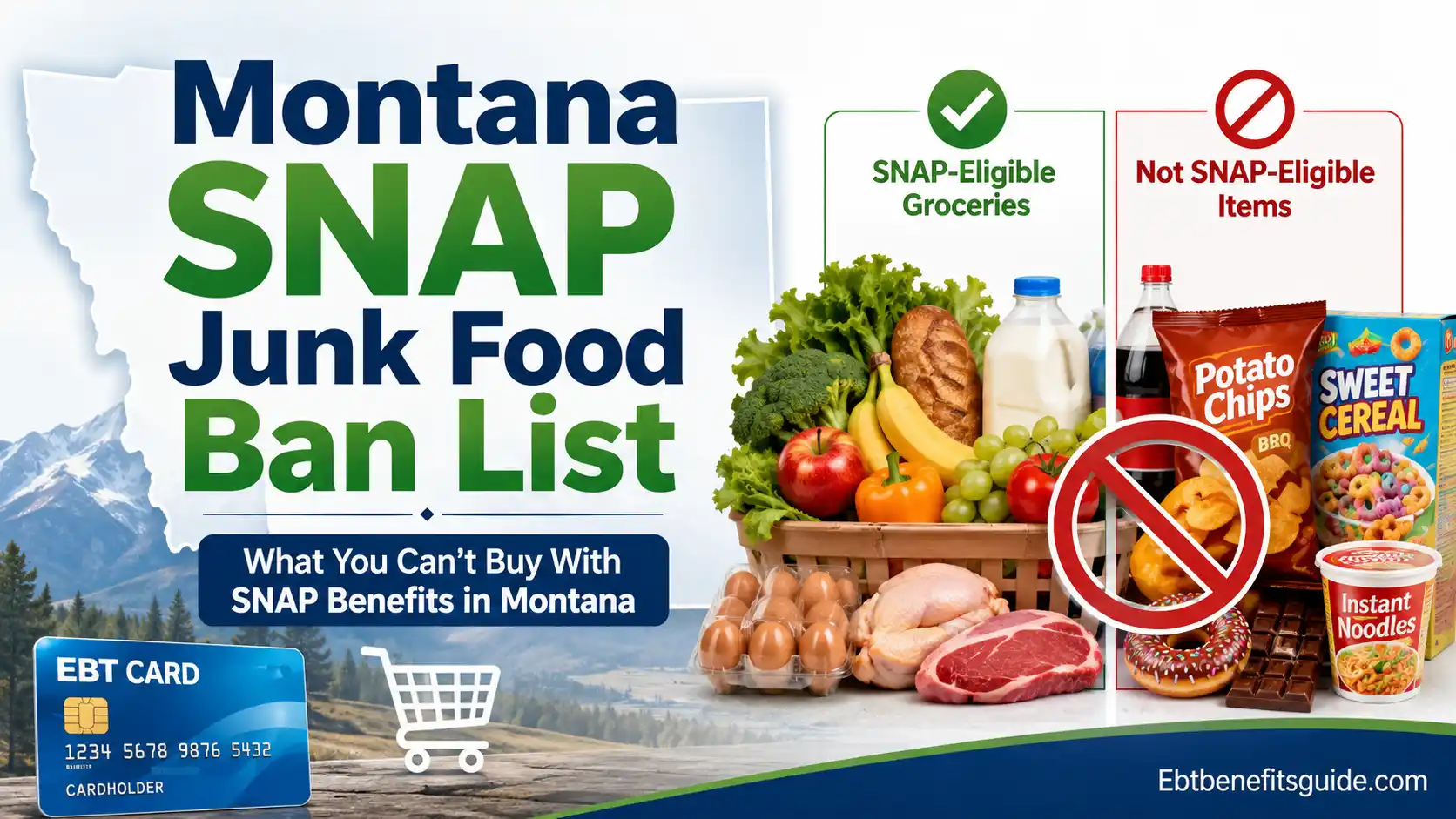
Starting September 30, 2026, four categories go off-limits for Montana SNAP purchases: candy, high-sugar beverages, energy drinks, and shelf-stable prepared desserts. There are real exceptions worth knowing — milk, certain juice drinks, coffee, tea, protein bars, meal-replacement bars, and store-made bakery items all stay eligible.
Montana’s waiver has already cleared USDA approval, and the restriction is set to go live statewide on September 30, 2026. It covers SNAP households and every SNAP-authorized retailer, including the ones that sell online.
What Foods Are Restricted?
| Category | Montana SNAP Restriction |
|---|---|
| Candy | Defined candy products, including gummies, licorice and hard candy |
| High-sugar beverages | Certain nonalcoholic drinks with more than 10g sugar per 8 fl oz |
| Energy drinks | Certain high-caffeine drinks containing specified stimulants |
| Shelf-stable prepared desserts | Certain processed, ready-to-eat, pre-packaged sweet foods |
The name “junk food ban” oversells it a little. Montana isn’t outlawing everything people casually call junk food — the waiver runs on specific product definitions, and just as many specific carve-outs.
Find Out If Other State’s Restricts SNAP Purchases
When Does the Montana SNAP Food Restriction Start?
September 30, 2026. Mark it down.
USDA approved Montana’s waiver on May 19, 2026, according to the U.S. Department of Health and Human Services. That gave the state a runway of several months before enforcement actually begins.
Retailers have work to do before launch, too. Getting SNAP point-of-sale systems to correctly flag restricted items falls on them, not on shoppers.
And this isn’t a permanent overhaul of federal SNAP rules — it’s a demonstration project. Montana’s own waiver materials point to an evaluation period stretching into 2028.
Montana SNAP Restricted Foods: Full List
1. Candy
Under Montana’s definition, restricted candy is a shelf-stable product built from sugar, honey, or other sweeteners combined with things like chocolate, fruit, nuts, or flavoring — usually shaped into bars, drops, or pieces.
The definition specifically includes:
- Gummies
- Licorice
- Hard candies
- Compressed sugar pieces
- Similar confectionery products
Not every sweet snack lands in this bucket, though.
Montana carves out baking ingredients, real-fruit snacks with no added sugar, granola, trail mix that’s mostly nuts or real fruit, protein bars, and meal-replacement bars.
2. High-Sugar Beverages
A restricted beverage here is nonalcoholic, carbonated or flat, and packs more than 10 grams of white sugar per 8 fluid ounces.
Several categories are excluded outright:
- Plain water
- Naturally flavored water
- Artificially sweetened beverages
- Beverages containing more than 50% fruit or vegetable juice by volume
- Meal-replacement beverages
- Medical-grade electrolyte replacement beverages
- Milk
- Milk-substitute products
Can you buy soda with SNAP in Montana?
Depends entirely on the sugar math. A sweetened carbonated or flat drink over that 10g-per-8oz line falls inside the restriction.
Don’t assume every can labeled “soda” is banned, and don’t assume every diet or zero-sugar drink is safe by default. Montana specifically excludes artificially sweetened beverages from this rule.
3. Energy Drinks
This one isn’t a blanket “no energy drinks” rule either.
A beverage counts as restricted when it hits:
- More than 6 mg of caffeine per fluid ounce, or
- More than 140 mg of caffeine per container
— plus at least one specified stimulant, such as taurine, guarana, glucuronolactone, ginseng, or yerba mate.
Coffee and tea sit outside this definition entirely. Though a coffee or tea drink could still get caught by the sugar rule instead, so it’s not a free pass on both fronts.
4. Shelf-Stable Prepared Desserts
Processed, shelf-stable, ready-to-eat, pre-packaged sweets built for immediate consumption — that’s the category. The definition cares about how the product is made and packaged, not just whether it tastes sweet.
Packaged desserts, snack cakes, cookies, and similar items can fall here if they meet Montana’s criteria.
Store-made bakery items are specifically excluded. That distinction — a factory-sealed dessert versus something baked fresh at your grocery store — actually matters a lot under this rule.
Unlock Montana EBT Discounts Before They Expire
What Can You Still Buy With Montana SNAP?
Plenty. The restriction doesn’t gut your grocery list.
Montana keeps these eligible:
- Plain or naturally flavored water
- Artificially sweetened beverages
- Beverages containing more than 50% fruit or vegetable juice
- Milk
- Milk substitutes
- Coffee
- Tea
- Protein bars
- Meal-replacement bars
- Certain fruit snacks
- Granola and qualifying nut/fruit-based products
- Store-made bakery items
Montana SNAP “Can I Buy It?” Guide
| Product Type | General Status | Important Point |
|---|---|---|
| Candy | Restricted | Subject to Montana’s candy definition |
| Gummies | Restricted | Specifically included as candy |
| Protein bars | Generally eligible | Listed as an exception |
| Meal-replacement bars | Generally eligible | Listed as an exception |
| Regular high-sugar soft drink | Potentially restricted | More than 10g sugar/8 oz is key |
| Artificially sweetened drink | Generally eligible | Specifically excluded from high-sugar beverage definition |
| Plain water | Eligible | Excluded from restriction |
| Milk | Eligible | Specifically excluded |
| Coffee | Eligible | Excluded from energy-drink definition |
| Tea | Eligible | Excluded from energy-drink definition |
| >50% fruit/vegetable juice | Eligible | Listed exception |
| Energy drink meeting definition | Restricted | Caffeine + stimulant criteria matter |
| Packaged prepared dessert | Potentially restricted | Must meet the full definition |
| Store-made bakery item | Generally eligible | Specific exception |
For anything borderline, trust the retailer’s point-of-sale classification over a brand name or a marketing label. Labels lie, sometimes; the system checking your SNAP eligibility doesn’t.
Does the Montana SNAP Ban Reduce Your Benefits?
No. Full stop.
This restriction changes what your SNAP dollars can buy — it doesn’t touch your benefit amount or your eligibility for the program itself.
So if a product turns out to be restricted, none of this happens:
- Your SNAP case doesn’t get cancelled.
- Your Montana Access Card keeps working.
- Your monthly allotment stays the same.
- You don’t have to reapply for anything.
The restricted item just can’t be paid for with SNAP. You’ll need another payment method for that one item.
How Will the Restriction Work at Checkout?
Point-of-sale systems handle the heavy lifting. Here’s the flow:
- You run your groceries through checkout.
- The retailer’s system sorts SNAP-eligible items from restricted ones.
- Eligible items get paid with SNAP.
- Restricted items need a different payment method.
- Online shoppers face the same rules at participating SNAP-authorized retailers.
One restricted item in your cart won’t tank the whole transaction. The system separates eligible from restricted automatically.
How to Tell if a Product Is Restricted
A five-step gut check:
Step 1: Identify the product category.
Step 2: For beverages, check sugar, caffeine, and ingredients.
3rd Step : Look for Montana’s listed exceptions.
Step 4: For desserts, ask if it’s shelf-stable, ready-to-eat, and pre-packaged.
Step 5: Still unsure? Check the retailer’s SNAP classification or Montana DPHHS guidance directly.
Safer than guessing based on gut feeling about what counts as “junk food.”
Does the Rule Apply Across Montana?
Yes — statewide, no exceptions by city. Billings, Missoula, Bozeman, Great Falls, Helena, Butte, Kalispell, and every smaller rural community fall under the same rule.
That consistency matters most in rural and tribal communities, where access to different retailers and alternative food options can vary widely. Montana’s demonstration includes evaluating exactly those purchasing patterns and access gaps.
Don’t go looking for a separate Missoula-specific or Bozeman-specific version of this rule. There isn’t one.
What About Shopping Online or Across State Lines?
Online shopping through SNAP-authorized retailers follows the same restrictions as in-store purchases.
Crossing state lines gets messier. Montana’s evaluation framework accounts for cross-border purchasing behavior, but that doesn’t mean another state’s rules — stricter or looser — will automatically apply to a Montana transaction.
Shopping outside Montana? Check that state’s current rules and retailer setup before assuming a product will ring up as SNAP-eligible.
Montana SNAP Restriction Timeline
| Date | Milestone |
|---|---|
| May 19, 2026 | USDA approval confirmed |
| August 2026 | Household communication and implementation preparation |
| September 15, 2026 | Retailer readiness target |
| September 30, 2026 | Scheduled restriction go-live |
| January 1, 2027 | Retailer grace period expected to end |
| October 1, 2028 | Anticipated demonstration expiration |
These dates can shift. Check Montana DPHHS directly before making a purchase decision that hinges on exact timing.
Also Check If You Still Qualify Under 2026 Limits
Common Mistakes to Avoid
Mistake 1: Calling everything “junk food.”
Montana’s rules run on categories and definitions, not vibes. A sweet product can still be eligible if it fits an exception.
Mistake 2: Assuming all soda is banned.
The sugar threshold — 10g per 8 fl oz — decides that, along with specific listed exceptions.
Mistake 3: Assuming all bars are off-limits.
Protein bars and meal-replacement bars are explicitly protected.
Mistake 4: Assuming all bakery products are restricted.
Store-made items are specifically excluded from the dessert rule.
Mistake 5: Thinking SNAP itself is being cancelled.
It’s not. This is a purchasing rule, not an eligibility rule.
FAQs About Montana Food Stamps Junk Food Ban
1. What foods are banned from SNAP in Montana?
Starting September 30, 2026, candy, high-sugar beverages, energy drinks, and shelf-stable prepared desserts lose SNAP eligibility — with exceptions for several beverages, bars, and bakery products.
2. Can you buy candy with SNAP in Montana?
Not if it meets Montana’s candy definition. Gummies, licorice, and hard candies are explicitly included, while fruit snacks, granola, protein bars, and meal-replacement bars are exceptions.
3. Can you buy soda with food stamps in Montana?
Some soda will be restricted, some won’t. The line is 10 grams of sugar per 8 fluid ounces — artificially sweetened sodas are excluded from that rule entirely.
4. Can SNAP buy energy drinks in Montana?
Not if the drink meets the caffeine-plus-stimulant definition. Coffee and tea are excluded from this category, full stop.
5. Can you buy protein bars with Montana EBT?
Yes. Qualifying protein bars are a named exception to the candy restriction — though it’s still worth checking the actual product classification rather than trusting the name on the wrapper.
6. Can you buy bakery items with SNAP in Montana?
Store-made bakery items stay eligible. Pre-packaged, shelf-stable desserts are a different story.
7. Does the Montana SNAP restriction affect my monthly benefits?
No. It changes what you can buy, not how much you receive or whether you qualify.
8. Does Montana’s SNAP restriction apply statewide?
Yes, across every SNAP household and SNAP-authorized retailer in the state.
9. Can I use Montana SNAP online?
Yes, at participating SNAP-authorized online retailers — the same restrictions apply there too.
10. When does the Montana SNAP junk food ban start?
September 30, 2026. USDA signed off on the waiver back on May 19, 2026.
Also See Your Exact Montana Deposit Date Now
Quick Answers
What are the four restricted categories?
Candy, high-sugar beverages, energy drinks, and shelf-stable prepared desserts — effective September 30, 2026.
Does Montana ban all junk food?
No. The rule runs on specific definitions and exceptions, not a general junk food label.
Are milk and coffee restricted?
No. Both stay eligible, along with milk substitutes and tea.
Does the restriction reduce SNAP benefits?
No. Purchasing eligibility changes; benefit amounts and household eligibility don’t.
How should I check a questionable product?
Look at category, sugar or caffeine content, ingredients, and Montana’s exceptions — then verify at checkout if you’re still unsure.
Conclusion
“Junk food ban” makes for a catchy headline, but Montana’s actual rule is narrower and more specific than that phrase suggests. Come September 30, 2026, four defined categories lose SNAP eligibility — nothing more, nothing less.
What matters most for Montana SNAP households: your benefits aren’t going anywhere. This is about what you can buy, not whether you still qualify.
Check the actual classification before you shop, especially for beverages, bars, and bakery items where the exceptions do a lot of heavy lifting. And when in doubt, Montana DPHHS has the final word — not an old news article, and not this one either.
Official Resources
- Check Montana’s Official Waiver Rules — DPHHS
- Verify the Federal Approval Details — USDA FNS
- Apply for SNAP Benefits — Montana DPHHS
- Check Your EBT Card Status — Montana Access
Disclaimer: This article is for general informational purposes and reflects Montana’s published 2026 SNAP restriction guidance available at the time of writing. Product classifications and implementation details can change. For an official determination, always confirm the current guidance from Montana DPHHS or your SNAP-approved retailer.

I am the author of EBTBenefitsGuide.com, with 3 years of experience covering SNAP and EBT benefits. They are dedicated to providing accurate, up-to-date details to help readers navigate government assistance programs with confidence.