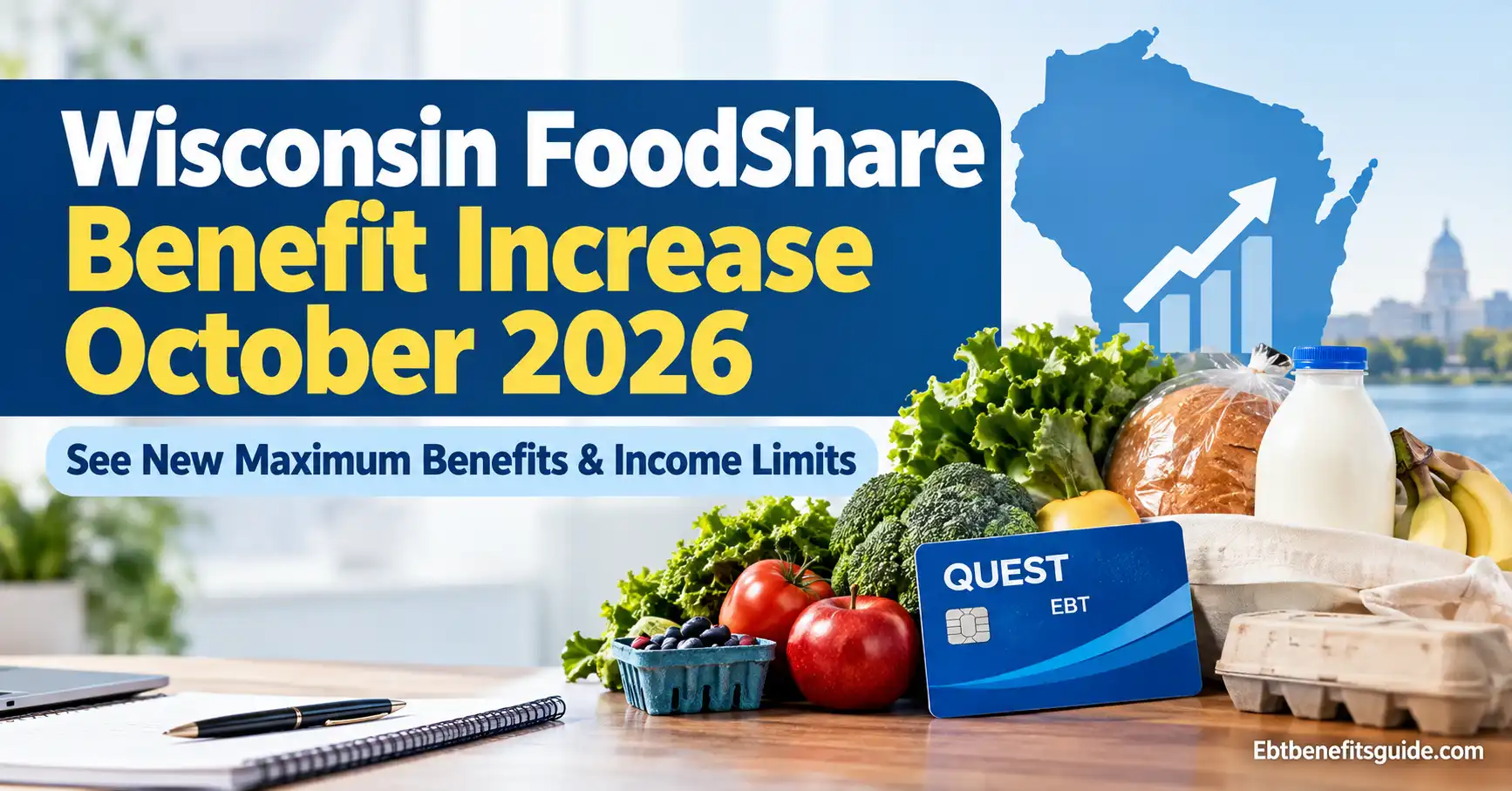
Wisconsin FoodShare benefits go up on October 1, 2026. This is the annual federal fiscal year 2027 Cost of Living Adjustment, and it touches almost every number tied to the program — maximum allotments, income limits, deductions, utility allowances, all of it.
The new maximum monthly allotment lands at $306 for a household of one and $1,023 for a household of four. That’s the ceiling, not a promise. What you actually get still comes down to your monthly income, your family size, and the deductions that apply to your case.
Wisconsin DHS made it official through DMS Operations Memo 26-32, issued September 16, 2026. It sets the FoodShare standards for Federal Fiscal Year 2027, running October 1, 2026 through September 30, 2027.
Did Wisconsin FoodShare Increase in October 2026?
Yes — and it’s not just the top-line benefit number. Income standards, deductions, utility allowances, and several eligibility thresholds all shifted at the same time.
This is the same mechanism that drives every state’s SNAP adjustment each fall. The USDA sets new maximums based on the Thrifty Food Plan, and states like Wisconsin fold that into their own memo. If you’re curious how the updated SNAP income limits by state compare, Wisconsin’s numbers track closely with the national pattern.
October 2026 FoodShare changes at a glance:
- Maximum allotments increased across all household sizes
- FoodShare income standards were updated
- Minimum monthly allotment for one- and two-person units rose to $25
- Maximum excess shelter deduction increased to $769
- Homeless shelter deduction increased to $206
- Standard deductions changed
- Standard utility allowances changed
- Certain asset and income-reporting thresholds shifted too
None of these are separate raises stacking on top of each other. Some are eligibility rules. Others feed into the math that produces your final benefit.
Wisconsin FoodShare Maximum Benefits October 2026
Here’s the full table of official FFY 2027 maximum monthly allotments, effective October 1, 2026.
| Household Size | Maximum FoodShare Benefit |
|---|---|
| 1 | $306 |
| 2 | $562 |
| 3 | $808 |
| 4 | $1,023 |
| 5 | $1,217 |
| 6 | $1,463 |
| 7 | $1,616 |
| 8 | $1,841 |
| 9 | $2,066 |
| 10 | $2,291 |
| Each additional person | +$225 |
FY2026 vs. FY2027 FoodShare Increase
| Household | FY2026 Maximum | FY2027 Maximum | Increase |
|---|---|---|---|
| 1 | $298 | $306 | +$8 |
| 2 | $546 | $562 | +$16 |
| 3 | $785 | $808 | +$23 |
| 4 | $994 | $1,023 | +$29 |
| 5 | $1,183 | $1,217 | +$34 |
| 6 | $1,421 | $1,463 | +$42 |
| 7 | $1,571 | $1,616 | +$45 |
| 8 | $1,789 | $1,841 | +$52 |
FY2026 figures were valid through September 30, 2026. Anything after that date runs on FFY 2027 numbers.
How Much FoodShare Will I Actually Receive?
Honestly, this is where most confusion starts. People see $306 and assume that’s what lands on their card. It isn’t — not automatically.
FoodShare runs your case through several factors before landing on a final number:
- Household size
- Countable gross income
- Net income
- Applicable eligibility rules
- Standard deductions
- Shelter expenses
- Utility expenses
- Medical or dependent-care expenses, when they qualify
- General household circumstances
Two households of the same size can get completely different amounts. Same number of people, different income, different deductions — different check.
Think of the maximum as a ceiling. Your actual benefit lives somewhere underneath it.
Wisconsin FoodShare Income Limits October 2026
There isn’t one single income cutoff for FoodShare. Wisconsin’s FFY 2027 standards list four separate thresholds, and which one applies depends on your situation.
| Household | 200% FPL Gross | 165% FPL Gross | 130% FPL Gross | 100% FPL Net |
|---|---|---|---|---|
| 1 | $2,660 | $2,195 | $1,729 | $1,330 |
| 2 | $3,608 | $2,976 | $2,345 | $1,804 |
| 3 | $4,554 | $3,757 | $2,960 | $2,277 |
| 4 | $5,500 | $4,538 | $3,575 | $2,750 |
| 5 | $6,448 | $5,319 | $4,191 | $3,224 |
| 6 | $7,394 | $6,100 | $4,806 | $3,697 |
| 7 | $8,340 | $6,881 | $5,421 | $4,170 |
| 8 | $9,288 | $7,662 | $6,037 | $4,644 |
| 9 | $10,892 | $8,443 | $6,653 | $5,118 |
| 10 | $11,840 | $9,224 | $7,269 | $5,592 |
What Do 200%, 165%, 130%, and 100% FPL Actually Mean?
Don’t treat these as four interchangeable limits. Each one does a different job.
200% FPL gross income shows up in specific eligibility and asset-rule contexts. 165% FPL applies under certain Wisconsin FoodShare pathways, including some elderly, blind, or disabled situations. 130% FPL gross is the standard most people picture when they think “FoodShare income limit.” And 100% FPL net income is different from all three — it’s calculated after deductions, not before.
Relying only on the 130% number to judge your own eligibility can lead you to the wrong conclusion. Your pathway matters. For a broader look at how these thresholds compare across states, the updated SNAP income limits by state breakdown is a useful reference.
Wisconsin FoodShare Deductions and Utility Allowances
Deductions shrink your countable income, which can raise your benefit. Wisconsin’s FFY 2027 standard deductions:
| Household Size | Standard Deduction |
|---|---|
| 1–3 | $217 |
| 4 | $229 |
| 5 | $268 |
| 6+ | $308 |
The maximum excess shelter deduction is $769. The homeless shelter deduction sits at $206.
FoodShare Utility Allowances
| Allowance | FFY 2027 Amount |
|---|---|
| Heating — HSUA | $930 |
| Limited — LUA | $466 |
| Electric — EUA | $149 |
| Water/Sewer — WUA | $120 |
| Cooking Fuel — FUA | $36 |
| Phone — PUA | $113 |
| Trash — TUA | $50 |
A utility allowance isn’t cash. It’s a standardized figure the state plugs into your calculation when it applies to your household.
Will My FoodShare Benefits Increase Automatically?
The COLA applies to eligibility determinations starting October 1 — you don’t need to do anything to trigger it. DHS sends a Notice of Decision if the adjustment changes your benefit.
You generally don’t need a new application just because the annual maximum moved. If you’re already enrolled, check your case file and any notice DHS sent you. ACCESS Wisconsin and the MyACCESS app both show your FoodShare details, including your QUEST Card balance and recent activity.
How Wisconsin Calculates FoodShare Benefits
The process, broken into steps:
- Determine the FoodShare household or assistance group
- Identify countable household income
- Determine which income and eligibility standards apply
- Apply allowable deductions
- Account for shelter and utility expenses
- Determine applicable net income
- Calculate the FoodShare allotment
- Compare the result against maximum and minimum rules
Any calculator you find online is an estimate. Full stop. The official number comes from DHS, based on the verification tied to your actual case.
What Happens If My October FoodShare Amount Looks Wrong?
Don’t assume the increase got skipped. Check these first:
- Your Notice of Decision
- Household size on file
- Reported income
- Recent income changes
- Rent or mortgage details
- Heating and utility expenses
- Medical expenses, if applicable
- Renewal status
- Any other eligibility changes
If something still looks off after that, contact your local income-maintenance office or Tribal agency. Wisconsin runs FoodShare through 11 income-maintenance consortia statewide, and they handle cases like interviews, benefit rules, renewals, and eligibility requirements questions directly.
Wisconsin FoodShare Local Help and Agencies
FoodShare is a statewide program — the maximum benefit is the same whether you’re in Milwaukee, Madison, Green Bay, Kenosha, Racine, Appleton, Waukesha, Eau Claire, La Crosse, Oshkosh, or Wausau.
Case services, though, run through county or Tribal agencies. Searching “FoodShare office near me” or “Wisconsin FoodShare agency” will point you to whichever office covers your county or Tribal service area. DHS keeps an official agency directory for exactly this purpose.
Other FoodShare Changes in 2026
Not everything happening around October 2026 traces back to the COLA. Wisconsin DHS’s 2026 Operations Memo library covers separate changes to work requirements, utility allowances, certification periods, noncitizen eligibility, drug-screening rules, and out-of-state QUEST Card use.
One example worth flagging: federal changes are affecting FoodShare eligibility for certain immigration statuses. DHS confirms some current members could lose eligibility under the new rules, with changes hitting affected FoodShare and Medicaid members no later than October 1, 2026. Keep this separate in your head from the FFY 2027 COLA — they’re unrelated changes that happen to land around the same date.
FoodShare Asset Rules for October 2026
The FFY 2027 memo updates a few asset figures too. For an Elderly, Blind, or Disabled food unit with at least one EBD member and gross monthly income above 200% FPL, the asset limit rises to $4,750.
The regular SNAP asset limit for non-EBD food units stays at $3,000. The lottery and gambling limit also climbs to $4,750.
How to Check Your Wisconsin FoodShare Benefits
If you’re already receiving benefits:
- Log in to ACCESS Wisconsin
- Review your FoodShare case information
- Check your Notice of Decision
- Confirm the effective date of any change
- Check your QUEST Card balance and recent activity
- Contact your local agency if something doesn’t add up
Beyond checking your case, it’s worth knowing where you can actually use those benefits — the EBT discounts by state guide covers retailer discounts tied to your card, and the SNAP food restrictions by state page lays out what you can and can’t buy. DHS offers several ways to apply too — online through ACCESS, by phone, in person at your agency, or via the Wisconsin FoodShare application directly.
Common Mistakes to Avoid
Using FY2026 numbers after September 30. The old maximums — $298 for one person, $994 for four — expired. FFY 2027 numbers take over October 1.
Assuming everyone gets the maximum. $306 and $1,023 are ceilings, not guarantees.
Treating 130% FPL as the only income rule. Wisconsin’s table includes multiple thresholds plus a net-income standard — use the one that fits your circumstances.
Treating utility allowances as cash. They’re calculation inputs, not extra deposits.
Assuming every October change is the COLA. Several unrelated policy shifts are happening around the same time.
Official Resources
- Apply for FoodShare Now — ACCESS Wisconsin
- Check FoodShare Program Details — Wisconsin DHS
- Verify SNAP Eligibility Rules — USDA FNS
- Find Your Local Agency — Wisconsin DHS Agency Directory
FAQs
Did Wisconsin FoodShare increase in October 2026?
Yes. Maximum allotments rose for FFY 2027, from $298 to $306 for one person and $994 to $1,023 for four people.
What is the maximum FoodShare benefit in Wisconsin in 2026?
$306 for one person, $1,023 for four, starting October 1, 2026. Larger households get proportionally higher maximums.
How much FoodShare does one person get in October 2026?
Up to $306 a month — that’s the ceiling for a one-person household under FFY 2027 rules.
How much FoodShare does a family of four get?
Up to $1,023 monthly, assuming the household qualifies for the full maximum allotment.
What is the Wisconsin FoodShare income limit for 2026–2027?
It depends on the standard. For one person: $2,660 at 200% FPL gross, $2,195 at 165%, $1,729 at 130%, and $1,330 at 100% FPL net.
Will everyone receive the FoodShare increase?
No. The maximum allotment increased, but your actual payment depends on income, deductions, and household circumstances.
Do current FoodShare recipients need to reapply because of the increase?
No, not because of the COLA alone. Check your DHS notice and case file for anything specific to your situation.
Why didn’t my FoodShare amount increase to $306?
Because $306 is a maximum, not a flat payment. Income, deductions, and household size can all pull your actual benefit lower.
Does rent affect Wisconsin FoodShare?
Yes, through the shelter deduction. The FFY 2027 maximum excess shelter deduction is $769.
Does heating affect FoodShare?
It can, through the Standard Utility Allowance system. The FFY 2027 heating allowance (HSUA) is $930.
Where can I check my Wisconsin FoodShare case?
ACCESS Wisconsin, the MyACCESS app, your Notice of Decision, or your local county or Tribal income-maintenance agency.
When does the new FoodShare amount start?
October 1, 2026, running through September 30, 2027, under the FFY 2027 standards.
Conclusion
The numbers are set, the memo is official, and the increase starts October 1 whether you check your account that day or not. What matters now is making sure your own case reflects reality — right household size, current income, deductions you actually qualify for.
If your payment date is what you’re really wondering about, the EBT payment schedule by state will tell you exactly when to expect your deposit. Everything else — the maximums, the income tables, the deductions — is just the math behind that number. Check your Notice of Decision, confirm the information, and you’ll know exactly where you stand.
Disclaimer: This article is for general guidance only and is not an official Wisconsin DHS eligibility determination. FoodShare policies and individual benefits can change. For a current case decision, verify your information with Wisconsin DHS or your local FoodShare agency.

I am the author of EBTBenefitsGuide.com, with 3 years of experience covering SNAP and EBT benefits. They are dedicated to providing accurate, up-to-date details to help readers navigate government assistance programs with confidence.