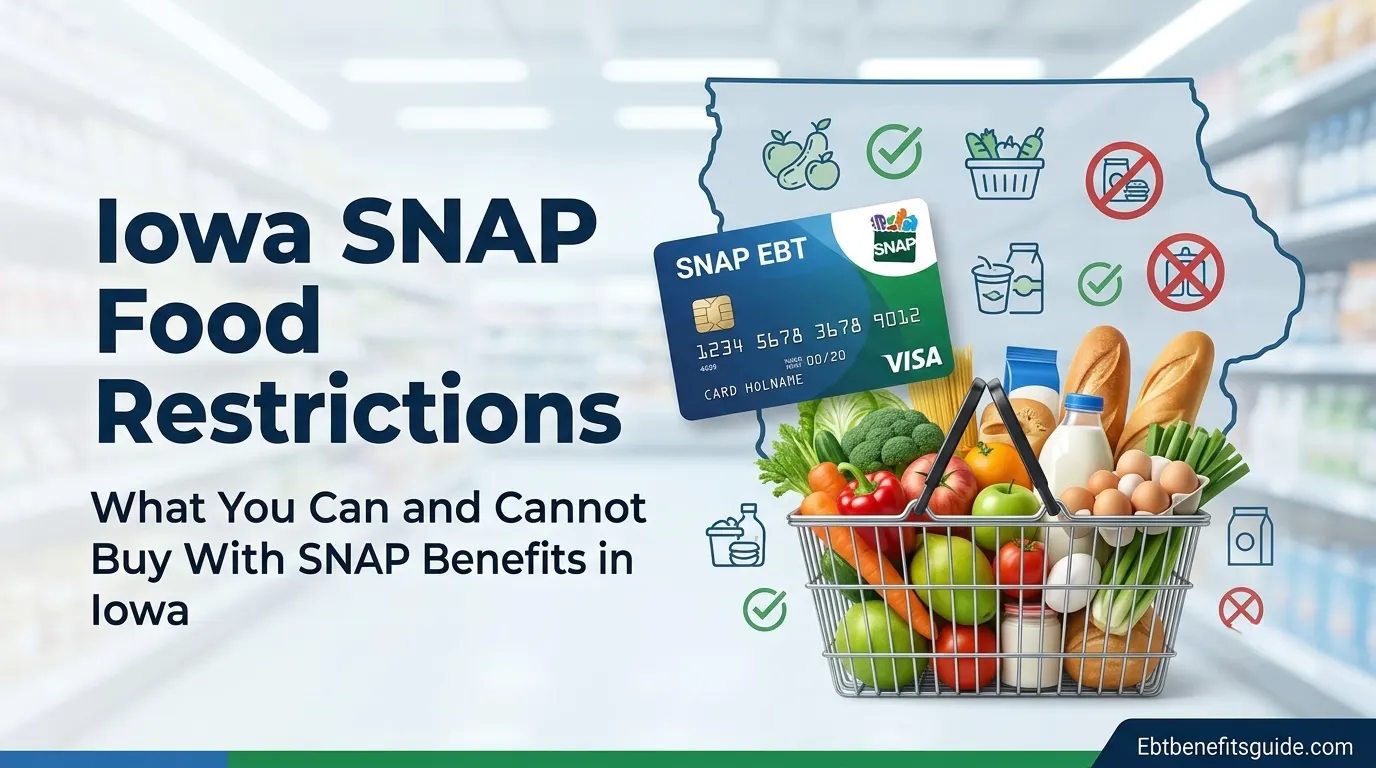
The Supplemental Nutrition Assistance Program (SNAP) supports qualified Iowa families buy food through an Electronic Benefits Transfer (EBT) card. Not everything in a store qualifies — and learning that at the register, mid-transaction, is not how you want to find out.
Iowa follows federal SNAP rules set by the USDA Food and Nutrition Service (FNS), with the Iowa Department of Health and Human Services (Iowa HHS) handling state-level control. Des Moines, Cedar Rapids, Davenport, Iowa City, Ames, Sioux City, Waterloo — same guidelines everywhere. Your zip code doesn’t change what you can buy.
What Are Iowa SNAP Food Restrictions?
Iowa SNAP food restrictions define exactly which products your EBT card will cover at checkout.
The short version: SNAP pays for food people eat. Alcohol, tobacco, vitamins, supplements, medicines, cleaning products, household goods — none of it. The program was built to put groceries on the table. That’s the lane it stays in.
How SNAP Benefits Work in Iowa
Benefits load onto your EBT card once a month. Approved retailers include grocery stores, supermarkets, farmers markets, and a growing list of online grocery services.
The register does the sorting automatically. Eligible items run through SNAP; everything else needs a second form of payment.
A typical split looks like this:
SNAP pays for:
- Chicken
- Rice
- Vegetables
- Milk
- Bread
You pay separately for:
- Soap
- Shampoo
- Laundry detergent
The system handles it — no manual separation required on your end.
Foods You Can Buy With Iowa SNAP Benefits
SNAP covers most standard grocery items. Here’s the breakdown by category.
Fruits and Vegetables
Fresh, frozen, canned — all covered. No distinction based on form.
- Apples
- Bananas
- Tomatoes
- Lettuce
- Frozen berries
- Canned beans
Meat, Poultry, and Seafood
Beef, chicken, turkey, pork, fish, seafood — fresh or frozen, both qualify.
Dairy Products
- Milk
- Cheese
- Yogurt
- Butter
Bread, Grains, and Cereals
Bread, rice, pasta, flour, tortillas, breakfast cereals — standard staples, all eligible.
Seeds and Food-Producing Plants
Here’s something most people don’t realize: SNAP covers seeds and plants that produce food. Vegetable seeds, herb seeds, tomato plants, pepper plants — if it grows something edible, it qualifies. Useful if you have any outdoor space at all.
Foods and Items You Cannot Buy With Iowa SNAP
These categories are excluded under USDA rules. No exceptions at the register.
| Item | SNAP Eligible? |
|---|---|
| Alcohol | No |
| Tobacco products | No |
| Vitamins | No |
| Dietary supplements | No |
| Medicines | No |
| Pet food | No |
| Cleaning supplies | No |
| Personal care products | No |
| Household supplies | No |
Why Are Vitamins and Supplements Not Covered?
Can SNAP buy vitamins? — people ask this constantly, usually because vitamins sit right next to food in most stores.
The answer is no. Supplements aren’t classified as food under SNAP regulations, regardless of where they’re shelved. That covers multivitamins, herbal supplements, nutrition capsules, and protein powders sold as supplements. The packaging tells you what category a product falls into — check the label, not the aisle.
Can SNAP Buy Energy Drinks in Iowa?
The label decides this one. An energy drink with a standard Nutrition Facts panel may qualify as a food product. The same drink with a Supplement Facts label does not.
Flip the can before you assume. Two products can look nearly identical and land in different categories entirely.
Can SNAP Buy Hot Food in Iowa?
No. Hot food prepared for immediate consumption is off the table — literally.
That covers:
- Hot pizza
- Hot deli meals
- Prepared restaurant meals
- Heated convenience store food
SNAP is for groceries you take home and cook yourself, not food that’s already ready to eat.
Can SNAP Buy Restaurant Food?
Almost never. A federal program called the Restaurant Meals Program (RMP) creates limited exceptions for elderly participants, people with disabilities, and those experiencing homelessness — but only in states that have opted in and at specifically approved restaurants. Iowa’s participation is limited, so don’t count on this as a reliable option.
Can SNAP Buy Baby Food?
Yes, when it’s actually food. Infant formula, baby cereal, baby food jars, infant snacks — all covered.
The non-food side of the baby aisle is a different story:
- Diapers
- Baby wipes
- Baby lotion
Same rule as everything else. If it’s not food, SNAP won’t cover it.
Can SNAP Buy Coffee?
Ground coffee, coffee beans, instant coffee — yes, all fine for home use.
A cup from a café or coffee shop? No. The distinction is preparation at home versus purchasing something already made.
SNAP Shopping Decision Guide: Is This Item Allowed?
Before assuming something qualifies, run through these four questions.
Step 1: Is it food?
If not, stop there — it almost certainly won’t go through on SNAP.
Step 2: Is it intended for human consumption?
- Milk, vegetables, meat — yes
- Pet food, cleaning products — no
Step 3: Is it classified as a supplement?
Words like supplement, vitamin, or herbal formula on the label are a reliable sign it won’t qualify. Check the panel, not just the front of the package.
Step 4: Is it hot prepared food?
Hot and ready to eat means it’s restricted.
Why Does an Iowa EBT Card Decline Certain Items?
A declined item doesn’t always mean a problem with your benefits. Several things can trigger it:
- The item isn’t SNAP eligible
- The product category is restricted
- The store’s system misclassified the item
- Insufficient balance
- A card or payment issue
If the decline seems wrong, ask the cashier to separate your items and run them through individually. System errors happen, and a specific item can sometimes be rung up differently.
Where Can You Use SNAP Benefits in Iowa?
SNAP EBT card allow at authorized retailers statewide — supermarkets, grocery chains, local food markets, eligible farmers markets, and participating online grocery platforms.
Worth confirming before you plan a trip for shopping: not every store that sells food is a SNAP-approved retailer. Look it up first rather than finding out at checkout.
Using SNAP Online in Iowa
More retailers accept SNAP EBT online now than even a few years ago. Before placing an order, run through this:
- Confirm the retailer accepts SNAP EBT
- Add only eligible grocery items to your cart
- Check whether delivery fees require a separate payment method
- Review your full order before paying
Delivery fees generally aren’t covered by SNAP — only the food itself.
Common Iowa SNAP Mistakes to Avoid
1. Assuming Everything in a Grocery Store Is Eligible
The store accepting SNAP and a specific product being SNAP-eligible are two separate things. One doesn’t guarantee the other.
2. Confusing Supplements With Food
“Natural,” “nutritional,” “healthy” — none of those words make a product SNAP-eligible. What matters is the regulatory classification, which you find on the label.
3. Forgetting Non-Food Items Need Separate Payment
Detergent, paper towels, toiletries — have a backup payment method ready before you get to the register.
4. Ignoring Product Labels
The label determines eligibility more often than people expect. Make it a habit to check before something goes in the cart.
You May Also Find Useful
- Check Your State’s EBT Payment Schedule — EBT Benefits Guide
- See Updated SNAP Income Limits by State — EBT Benefits Guide
- Find EBT Discounts Available in Your State — EBT Benefits Guide
- See Full SNAP Food Restrictions by State — EBT Benefits Guide
Quick Iowa SNAP Eligible vs Restricted List
| Usually Allowed | Usually Not Allowed |
|---|---|
| Fruits | Alcohol |
| Vegetables | Tobacco |
| Meat | Vitamins |
| Seafood | Supplements |
| Dairy | Medicines |
| Bread | Pet food |
| Rice | Cleaning products |
| Seeds | Household goods |
Frequently Asked Questions (FAQs)
1. What foods cannot be bought with SNAP in Iowa?
Alcohol, tobacco, vitamins, supplements, medicines, pet and cat food, housing items, and hot prepared foods are all excluded.
2. Can SNAP buy junk food in Iowa?
Yes. Chips, cookies, and candy are generally SNAP-approved. The rules are depends on item category, not whether something is healthy.
3. Can SNAP buy protein powder?
Usually no — most protein powders carry a dietary supplement classification, which puts them outside SNAP coverage.
4. Can SNAP buy diapers in Iowa?
No. Non-food household item, full stop.
5. Can SNAP buy seeds in Iowa?
Yes. Seeds and plants that produce food are explicitly covered under SNAP.
6. Can SNAP buy fast food in Iowa?
Generally no, with very narrow exceptions through limited special programs.
7. Can SNAP buy groceries online in Iowa?
Yes, through retailers that have been approved to accept Iowa SNAP EBT for online orders.
8. Why did my Iowa EBT card decline at checkout?
Could be an ineligible item, low balance, retailer system error, or a card issue. Ask the cashier to separate items if you’re not sure which triggered it.
9. Can SNAP buy energy drinks?
Depends entirely on the label. Nutrition Facts panel — possibly yes. Supplement Facts panel — no.
Conclusion
The food versus non-food line handles most of the confusion on its own. Where people actually get caught is the gray zone — supplements marketed as health products, energy drinks with ambiguous labels, hot food at a deli counter. Those are the situations worth thinking through before you shop, not after.
Check with Iowa HHS or the USDA Food and Nutrition Service for anything that’s changed recently. Retailer participation and program details do get updated.
Official Resources
- Check What SNAP Covers — USDA Food and Nutrition Service
- Apply for SNAP Benefits in Iowa — Iowa HHS
- Find SNAP-Approved Retailers Near You — USDA Store Locator
- Verify Iowa EBT Account Balance — Iowa EBT Portal
Disclaimer: This guide gives general information regarding Iowa SNAP food restrictions and is not legal or official benefits guidelines. SNAP policies may change, so always check current requirements with Iowa HHS or USDA resources before making any decisions.

I am the author of EBTBenefitsGuide.com, with 3 years of experience covering SNAP and EBT benefits. They are dedicated to providing accurate, up-to-date details to help readers navigate government assistance programs with confidence.